

CALL US NOW 6288 8323
PVC Canvas Outdoor Blinds
Singapore’s most affordable option

What makes PVC canvas blinds worth it for outdoor spaces
PVC canvas blinds are one of the most practical and budget-friendly ways to cover an outdoor area — and they’ve been a go-to choice for homeowners and businesses alike for good reason.
Unlike heavier alternatives, they let natural light filter through while still keeping wind, rain, and dust out. Depending on the opacity you choose, you can get full light penetration for a bright, open feel, or a semi-opaque finish that softens the glare without closing off the view entirely.
The material itself is worth talking about. These blinds are made from high-grade PVC, which means they hold up well against daily wear — scratches, moisture, and the kind of sustained outdoor exposure that would degrade cheaper options quickly. They’re genuinely waterproof, not just water-resistant, which matters if you’re covering a space that gets heavy afternoon rain.
Beyond durability, the canvas has built-in sun protection properties. It reduces heat build-up, blocks harmful UV rays, and offers a degree of privacy — all without the bulk of a solid wall or permanent structure. That combination makes them especially popular for restaurant and café fit-outs, where you need a comfortable, weather-protected environment that still feels open.
For home use, they work beautifully across balconies, patios, verandas, and service yards. They have a manual pulley system that anybody can operate without any tools or technical knowledge.
If you want an outdoor covering that’s low-maintenance, long-lasting, and easy on the budget — this is a strong place to start.
______
Types & features of canvas blind
Canvas blind material options
Discover our range of canvas blinds with UV protection, waterproof features, durability, and customizable designs.
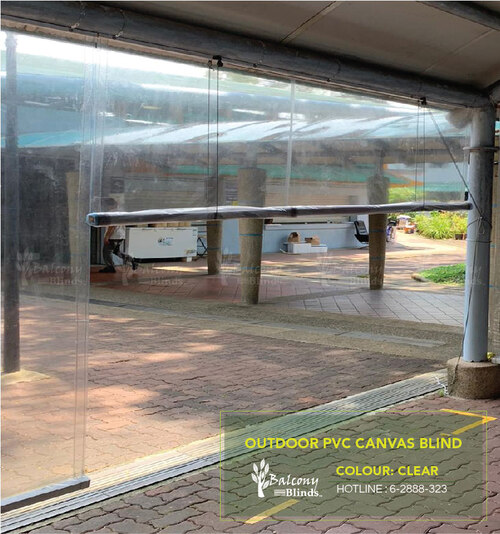
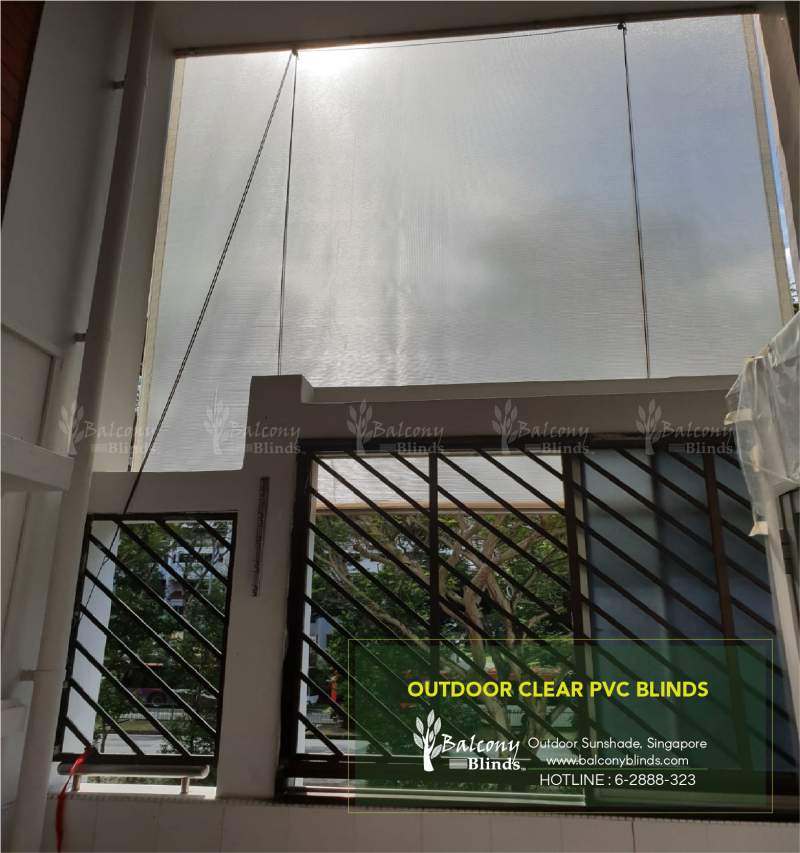
Clear (non-gridded)

_
Material: PVC Canvas
Max Width: 3m
Size: Custom-Made; Customized in accordance with slanted trellis
Pulley System: Manual
Weight: Lightweight
Function: Weather Resistant
Maintenance: Minimum
Installation Type: Outdoor / Exterior Installation
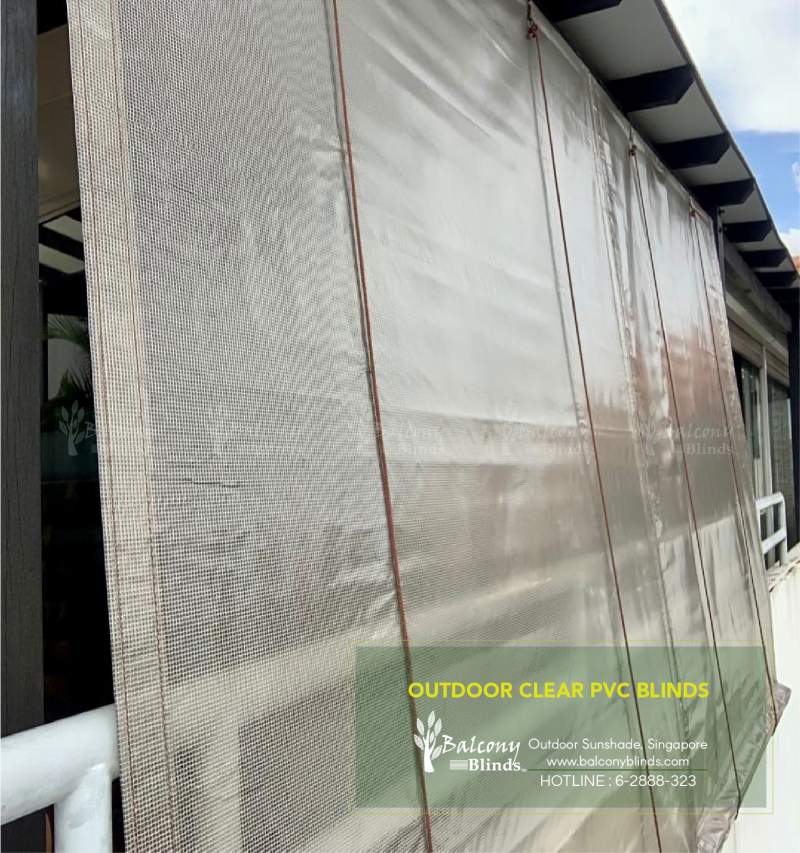
White grid
 White Grid
_
Material: PVC Canvas
Max Width: 3m
Size: Custom-Made; Customized in accordance with slanted trellis
Pulley System: Manual
Weight: Lightweight
Function: Weather Resistant
Maintenance: Minimum
Installation Type: Outdoor / Exterior Installation
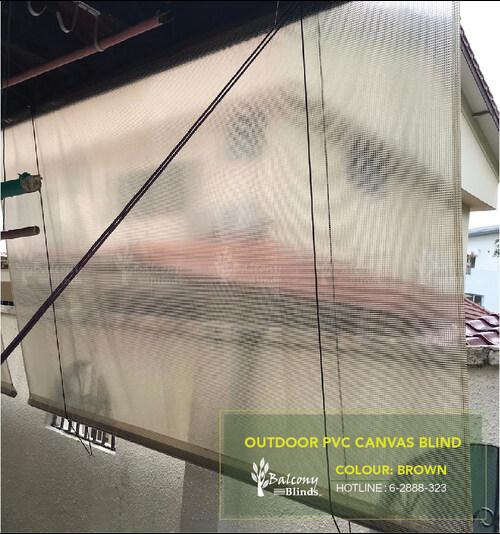
Brown grid
 Brown Grid
_
Material: PVC Canvas
Max Width: 3m
Size: Custom-Made; Customized in accordance with slanted trellis
Pulley System: Manual
Weight: Lightweight
Function: Weather Resistant
Maintenance: Minimum
Installation Type: Outdoor / Exterior Installation
Why PVC Canvas Blinds are Ideal for Singapore’s Tropical Climate
Living in Singapore means dealing with intense afternoon sun, sudden heavy downpours, and humidity that doesn’t really let up — not just occasionally, but every single day of the year. Standard fabric blinds or timber shutters can warp, mould, and fade fast under those conditions. PVC canvas blinds are built differently.
They’re designed specifically to handle what Singapore’s weather throws at them: repelling rain, blocking UV, standing up to moisture, and still looking good after years of use. Whether you’re outfitting a HDB balcony, a landed property’s outdoor space, or a commercial shopfront, PVC canvas blinds offer a practical, long-lasting solution that genuinely suits the climate — not just on paper, but in real, day-to-day use.
What PVC canvas blinds are
PVC canvas blinds are outdoor blinds manufactured from heavy-duty transparent polyvinyl chloride sheet material, typically reinforced with woven canvas edging or an internal grid structure that maintains shape under load. The material is fully waterproof, dimensionally stable under tropical conditions, and available in clear non-gridded form or in white and brown grid variants depending on project requirements.
Most systems in Singapore are custom fabricated to the exact opening dimensions and operate via a manual pulley mechanism. The blind rolls up when not in use and deploys downward to close the opening against rain, wind, and environmental debris.
The transparency of the PVC sheet is the defining characteristic that separates PVC canvas blinds from most other outdoor blind types. When the blind is down, the space remains visible and naturally lit rather than enclosed and dim.
Why PVC canvas blinds work well in Singapore
Singapore receives approximately 2,340 millimetres of rainfall annually, distributed across the year with intensified periods during the northeast monsoon from November to January and the southwest monsoon from June to September. Afternoon thunderstorms are common throughout the year. Outdoor spaces without weather protection become genuinely unusable for large portions of any given week.
Most shade products address the heat problem. PVC canvas blinds address the rain problem.
When properly installed, a PVC canvas blind significantly reduces rain intrusion into balconies, patios, service yards, and covered walkways. Performance depends on installation quality, the geometry of the opening, and wind direction during rainfall, but the practical improvement for typical residential and commercial applications is substantial.
For condominium properties, each development’s Management Corporation Strata Title sets its own by-laws governing outdoor blind installations. These typically regulate permitted colours, materials, and whether prior written approval is required before installation proceeds. Installing without MCST approval where approval is required can result in a breach notice requiring removal at the homeowner’s cost.
URA’s general position is that retractable balcony screens that are not permanent enclosures and meet openness criteria do not incur additional Gross Floor Area charges, but verification with your MCST and a qualified installer is essential before committing to any system.
Professional site measurement and installation by an experienced contractor familiar with local compliance requirements is strongly recommended.
PVC canvas blinds vs zip blinds
The comparison between PVC canvas blinds and zip-guided outdoor blind systems comes up frequently because both address rain protection, but they approach it differently.
PVC canvas blinds use a transparent rigid sheet and typically operate via a manual pulley. They excel at rain exclusion and clear visibility at an economical price point. Wind resistance is moderate, as side guidance depends on installation configuration.
Zip blinds use a tensioned fabric panel guided within side channels that lock the edges of the blind against wind load, making them significantly more effective in high-wind conditions. Premium systems support motorisation and are available in screen fabrics that provide openness percentages from one to ten percent, allowing ventilation control alongside weather protection. The trade-off is cost: zip blinds represent a premium investment relative to PVC canvas systems.
For homeowners whose primary concern is keeping rain out of a sheltered balcony or service yard at a practical price, PVC canvas blinds are frequently the appropriate choice. For exposed high-rise installations where wind load is a serious consideration, or where aesthetics and motorisation are priorities, a zip system warrants evaluation.
Maintenance and service life
PVC canvas blinds are among the lower-maintenance outdoor blind options available. The non-porous surface does not absorb water, trap pollen, or accumulate mould the way woven outdoor fabrics do.
Routine cleaning involves wiping down the PVC surface with a soft cloth, mild soap, and water. For outdoor installations exposed to dust or road grime, a periodic wash-down is sufficient. Avoid abrasive cleaning agents or rough materials that can scratch the surface and accelerate UV degradation by removing any surface treatment.
Retracting the blind during very strong wind events and extended periods of direct afternoon sun exposure when the blind is not needed will meaningfully extend service life.
Selecting the right PVC canvas blind
The main decisions when specifying a PVC canvas blind are material type, opening size, and configuration.
Beyond rain, PVC canvas blinds also reduce wind-driven dust and debris. Homes near roads, parks, or active construction sites accumulate surface dust at a rate that makes uncovered balconies and service yards difficult to maintain. A lowered PVC blind cuts this significantly.
Material considerations for Singapore’s climate
Not all PVC performs equally in tropical conditions.
Standard PVC is vulnerable to UV degradation over time. Prolonged exposure to intense ultraviolet radiation breaks down the polymer chains in the material, causing yellowing, surface brittleness, and eventual cracking along edges and stress points. In Singapore, this process is accelerated by the near-equatorial UV index, high ambient temperatures, and year-round sun exposure without the seasonal relief that temperate-climate installations experience.
For long service life, the relevant question when selecting PVC canvas blinds is whether the material contains UV stabilising additives that slow this degradation. UV-stabilised PVC retains clarity and flexibility substantially longer than untreated sheet material. This is not a cosmetic consideration: a blind that yellows to near-opacity within three years has lost much of its functional value as a see-through weather barrier.
High-grade UV-stabilised PVC canvas blinds installed under correct conditions can provide five to ten years of reliable performance. Service life depends on direct sun exposure, whether the blind is retracted during extreme weather, and the regularity of basic maintenance.
Common applications in Singapore
Balcony enclosures are the most common residential application. Condominium and HDB balconies that face prevailing wind or receive afternoon rain benefit immediately from PVC canvas blinds. The blind can be lowered during wet weather and retracted on dry, breezy mornings, preserving the open character of the space when conditions allow.
Service yards benefit because PVC blinds reduce rain intrusion while maintaining ventilation and visibility, allowing laundry areas to remain functional during wet weather.
Restaurants, cafés, and outdoor dining operators install PVC canvas blinds extensively to protect alfresco seating areas during rain without enclosing the space permanently. The transparency maintains the open-air atmosphere that defines alfresco dining even when the blind is deployed.
Landed property patios, covered walkways, school corridor sections, and light industrial covered areas are also established application categories.
PVC canvas blinds and HDB or condominium compliance
Before installation in any HDB flat or condominium, compliance with the relevant authority’s requirements must be confirmed.
For HDB properties, only retractable or roller-type blinds are permitted. The system must be installed within the balcony boundary and must not obstruct emergency egress. These requirements are consistent with HDB’s published guidelines on balcony fixtures.
Material type covers clear non-gridded PVC, white grid PVC, and brown grid PVC. Clear non-gridded offers the best visibility and the most transparent appearance when lowered. Grid variants provide some additional dimensional stability and are preferred by some for aesthetics.
Opening size affects fabrication requirements. Wider openings may require reinforcement, centre supports, or multiple blind sections rather than a single panel. The maximum practical single-panel width is typically around three metres for manual pulley systems.
The orientation and exposure of the installation matter significantly. A balcony sheltered by an overhead slab and facing north requires different specification from an exposed west-facing patio that receives direct afternoon sun for six or more hours daily. The latter needs UV-stabilised material as a minimum and benefits from more frequent retraction when the blind is not in use.
Get your free site assessment
We measure, assess exposure conditions, recommend the right system,
and provide a full quotation — no obligation.
Frequently asked questions
Yes. The PVC sheet material is fully waterproof and designed for outdoor rain exposure.
They significantly reduce rain intrusion under typical installation conditions. Performance in severe wind-driven rain depends on installation configuration and gap management at the edges and bottom. No outdoor blind system, including zip blinds, is entirely impervious under every weather condition.
Yes. Transparent PVC maintains clear outward visibility when the blind is deployed. This is one of its primary advantages over opaque outdoor fabrics.
Yes, provided the system is retractable, installed within the balcony boundary, and does not obstruct emergency exits, consistent with HDB guidelines.
PVC canvas blinds provide some reduction in direct solar exposure when lowered, but heat reduction is secondary to their weather-barrier function. Perforated sunscreen fabrics or specialised outdoor solar blinds are more effective for heat management as a primary objective.
UV-stabilised PVC canvas blinds in a well-maintained installation can provide five to ten years of reliable service under Singapore conditions. Service life is reduced by prolonged direct sun exposure, infrequent cleaning, and leaving the blind deployed in extreme wind events.
Standard options are clear non-gridded PVC, white grid PVC, and brown grid PVC. Custom widths and heights are fabricated to measurement.
Most PVC canvas blind systems use manual pulley operation. Motorisation is possible in selected configurations but is not standard for this blind type.
Pricing depends on opening dimensions, floor count, site access conditions, material grade, and operating system. PVC canvas blinds are consistently more economical than premium zip-guided systems, which makes them a popular first choice for homeowners who need weather protection without the investment required for a motorised or track-guided system.
Yes, widely. PVC canvas blinds are a standard solution for covered outdoor dining areas because they protect seating from rain while keeping the space visually open and well-lit.
______
Our Completed Canvas Blind Projects
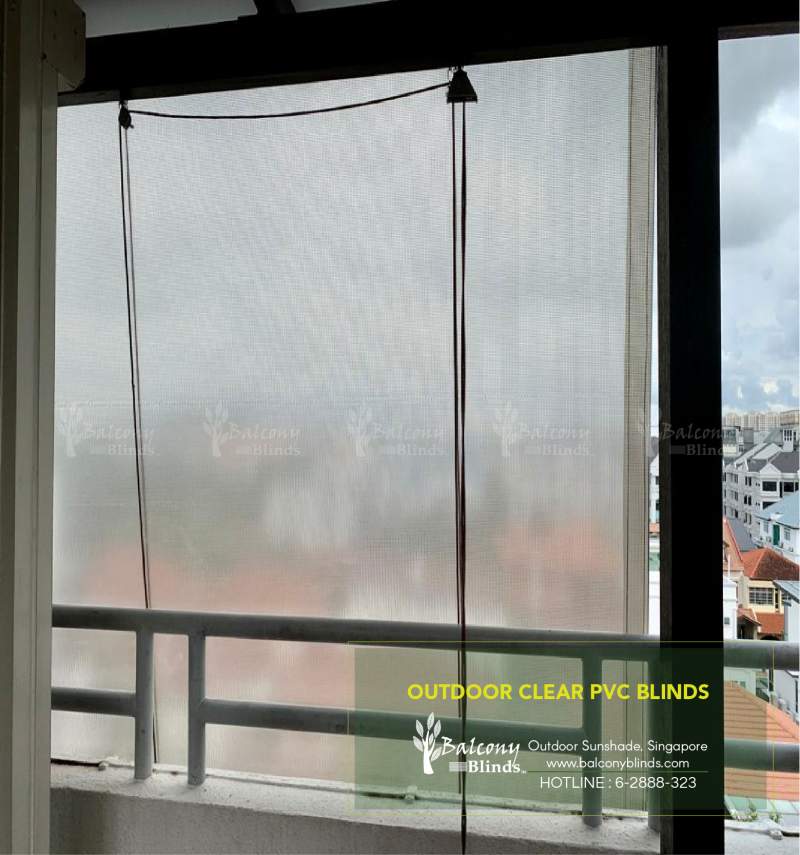
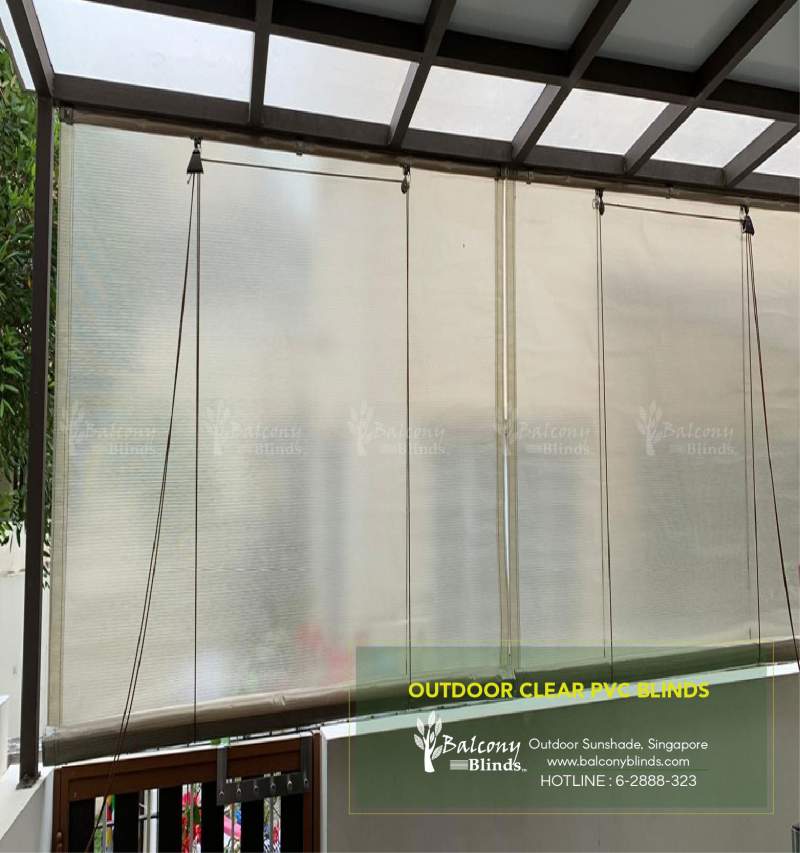
Enjoy the outdoors in comfort with our blinds
Request a free consultation with our experts today!
Call Now 6288 8323